Riding from Vallejo to Sacramento is a relatively easy ride, I think I could do it on a bicycle, add 1 1/4hp and it’s easy for sure, but things were about to change and get a lot steeper.
May 18, 1903
(Sacramento to Colfax, CA)
“It was late when I awoke, and almost noon when I left the beautiful capital of the Golden State. The Sierras and a desolate country were ahead, and I made preparations accordingly. Sacramento’s but 15 feet above sea level; the summit of the range is 7,015 feet.
Three and a half miles east of Sacramento the high trestle bridge spanning the main stream of the American River has to be crossed, and from this bridge is obtained a magnificent view of the snow-capped Sierras.
Today’s view of the bridge is similar, there seems to be a little modification to some of the upper section, but the view of the sierras, that’d be a no, well not for me anyway on the day I was there, the sky was clear but maybe some of that famous Califonia smog reduced distance visibility.
“the great barrier that separates the fertile valleys and glorious climate of California from the bleak and barren sagebrush plains, rugged mountains, and forbidding wastes of sand and alkali that, from the summit of the Sierras, stretch away to the eastward for over a thousand miles.”
The view from the American River bridge is imposing, encompassing the whole foothill country, which “rolls in broken, irregular billows of forest crowned hill and charming vale, upward and onward to the east, gradually growing more rugged, rocky, and immense, the hills changing to mountains, the vales to canyons until they terminate in bald, hoary peaks whose white, rugged pinnacles seem to penetrate the sky, and stand out in ghostly, shadowy outline against the azure depths of space beyond.”
A few miles from Sacramento is the land of sheep. The country for miles around is a country of splendid sheep ranches, and the woolly animals and the sombreroed ranchmen are everywhere.
Speeding around a bend in the road I came almost precipitately upon an immense drove which was being driven to Nevada.
While the herders swore, the sheep scurried in every direction, fairly piling on top of each other in their eagerness to get out of my path. The timid, bleating creatures even wedged solidly in places. As they were headed in the same direction I was going, it took some time to worry through the drove.
The pastoral aspect of the sheep country gradually gave way to a more rugged landscape, huge boulders dotting the earth and suggesting the approach to the Sierras.
I’d love to show you a modern-day photo of some sheep, and sheep herders in California, but I can’t!
I went to the interwebs to ask why? –
Wool prices are so low that they do not justify sheep ranching.
Sheep are still more profitable on a per-hectare basis, however, even when raised only for meat. They breed more often, are weaned and marketed younger, and produce twins often.
Many cowboys will not raise sheep, however, and there are good reasons. You can surround your land with a few strands of barbed wire, and release your cows, and they are pretty much labor free.
Sheep are a daily hassle. (watch the first series Clarkson’s Farm on Amazon Prime, it’ll show you these exact problems)
If you try to fence them in they will find a hole and get out.
If you have predators or stray dogs you have to watch them constantly and provide some sort of livestock guard. You have to check them every day to make sure no problems are developing in their feet. Sheep need to be dewormed more often, and if you are a cattle rancher with little spare labor available all of this is just too much.
Those of us who bother with sheep usually do it because we like working with sheep. Profit is not even part of the issue. Most cattle ranchers are not willing to take on this task.
Back to George’s story…
At Rocklin the lower foothills are encountered; the stone beneath the surface of the ground makes a firm roadbed and affords stretches of excellent goings. Beyond the foothills the country is rough and steep and stony and redolent of the days of ’49.
**I’m guessing he is talking about the way the track is, as it originally was the route for the gold miners and gold rush to get to this area in 1849
It was here and hereabouts that the gold finds were made and where the rush and “gold fever” were fiercest. Desolation now rules, and only heaps of gravel, water ditches, and abandoned shafts remain to give color to the marvelous narratives of the “oldest inhabitants” that remain.
He passed through Rocklin, a similar era photo, and modern-day in the same location
I love the juxtaposition of this shot, a modern motorcycle and an electric car, 120 years of change
Right across the street is the train line and the newer station that he passed by…
The steep grades also remain, and the little motor was compelled to work for its “mixture”. It “chugged” like a panting being up the mountains, and from Auburn to Colfax – 60 miles from Sacramento – where I halted for the night, the help of the pedals was necessary.”
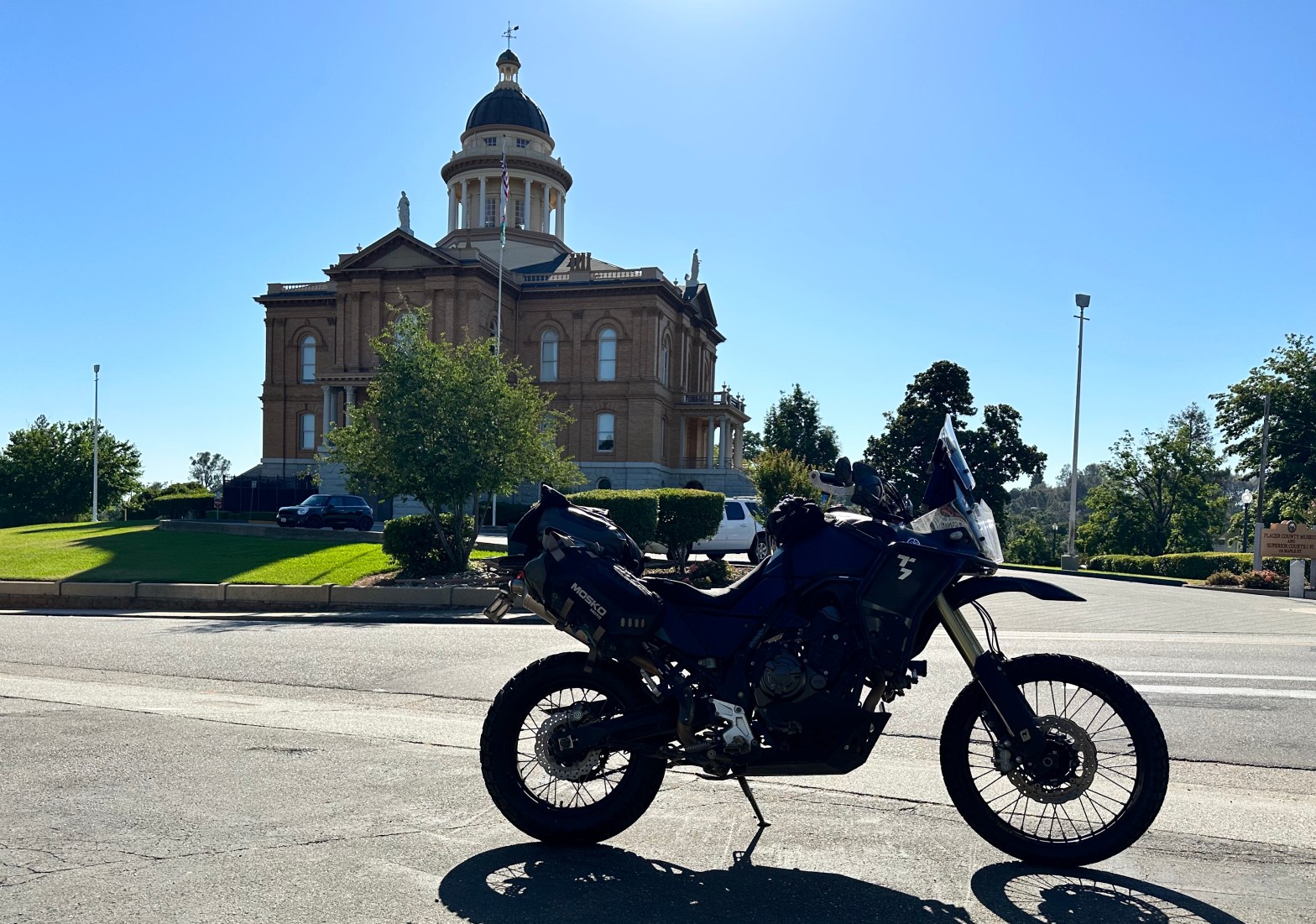
Passing through Auburn, then and now of the courthouse, a very interesting town with a lot of Gold Rush-era history
*not a Wyman photo
You do find yourself looking a little closer at buildings for dates on the structure, wondering if this bank got held up at gunpoint sometime in its history, or is that just old cowboy movies influencing my brain?!
*George and his bike leaning against the Colfax train depot building
The depot is there today but a new building is in its place
There was no mention of where he stayed, but George was on an all-expenses-paid trip, would you stay in the best hotel in town? The recently opened Gillen Hotel, later called the Colfax Hotel opened its doors for business in 1903
…and this is where I found my first waypoint sign, the hotel is now an abandoned building
The route so far…
continued…

 rtwPaul