
Reno has a local government so in 1903 it was considered a town, but only had the population of a larger village, at that time it was the place to go for a quickie divorce and still is today.
It’s funny to read George thought Reno would disappear, but now has a population of around 275,000 people.
Gambling didn’t (legally) start in Reno until 1931 when Nevada legalized gambling…it was happening already!
May 21, 1903
(Reno to Wadsworth, NV)
“Waking in Reno, Nevada, on a May day morning, the 21st of the Month, I found snow falling thickly and the ground unfit for riding.
Considering that I was only about 250 miles on my journey from San Francisco, I heaved a sigh that was almost a moan as I realized that I was to meet delay so soon.
I had slept in a hotel – a good one as hotels go in this country – and, after a very satisfactory breakfast, I looked about for something to beguile the time away. I was in hard luck because I do not gamble, drink, smoke, or chew. The old time picturesqueness of Reno has departed, but it is still a town of the West, western, and a man of no habits is at a discount in it.
There is plenty of opportunity for drinking and gambling about, but for little else. I killed some time profitably by overhauling my machine, and after dinner I concluded to get under way.
It was a quarter past two in the afternoon when I left Reno and I had lost a good eight hours of riding time. The snow had ceased falling, but the skies were still overcast and the ground very wet as I set forth toward Wadsworth and the great Nevada desert.
There is no mention of the route George took out of town, or the hotel he stayed at but looking at the 1900 map…
…there’s a very good chance he rolled by here at Virginia and 2nd Street
…which is almost exactly the same today except for the gaudy RENO sign just down the block
My weather was a little different it was already in the mid 90’s, so my issues were a little different.
For about 18 miles the road was fair, and then it began to get sandy. Sand in Nevada means stuff in which you sink up to your ankles every time you attempt to take a step. To further enliven matters it began to rain. Every now and then I had to dismount and walk for a stretch of a quarter of a mile.
Several times the soft sand threw me because I did not respect it enough to dismount in time. A bicycle with a six horsepower motor could not get through such sand. The wheel just swings out from under, and the faster you try to go the worse it is.
Walking and riding. I managed, however, to make the 36 miles from Reno to Wadsworth in four hours and there I pitched camp for the night.
Wadsworth today is still nothing, around 700 people live here, and it’s part of the Paiute Indian Tribal Land, entering the area there’s a rail bridge that he may have crossed.
It is well to put in a word of warning and explanation right here: When mention is made of the places at which I stopped and through which I passed it must not be imagined that they are all cities, or towns, or villages, or hamlets, or anything in the nature of civilized settlements.
The majority of them are nothing of the sort. They are just places – and it seems a waste of good English to call them that.
It is to be remembered that I started out determined to follow the line of the Southern Pacific and Union Pacific railroads as far east as Omaha, because it is the direct route.
The road runs almost in a straight line across the great alkali desert between the mountain summits. To have gone around the desert, through the mountains to the north would have meant traveling many hundreds of miles more, and I would of a certainty have been lost many times, for there are nothing but trails to follow and often not any visible trail.
If you take a map of the Union Pacific Railroad you will see the line of it studded with names as closely as they can be printed. and if you have not crossed the continent you will very naturally be deluded into thinking of them as villages at least.
These are the “places” through which I passed, or, rather past which I rode, for I was riding right on the tracks most of the way. They are localities arbitrarily created by the railroad.
Many of them are nothing more than names given by the railroad officials to designate a sidetracking junction, and when you reach it all you see is the sidetrack and a signpost put there by the railroad; other places bearing names are mere telegraph stations, one eating stations for passenger trains, while still others are what are known as stations.
These places all exist because of the railroad. It is to be remembered that it is a single track road all the way from Omaha to San Francisco, and therefore there is need of sidetracking at frequent intervals. This means telegraph houses or sheds for the operators, and in order to issue instructions definitely all places must be named.
There are the section hands and their foremen – they make a place for themselves and it gets a name and a position on the map, even though there is only the house of the foreman and a couple of others for the laborers, as is often the case.
The divisions are places where the freight and passenger trains change engines. Quite often they are something of places, with from 200 to 5,000 population.
There, two or three hotels will be found, several saloons, and a couple of stores. The stranger marvels to find a community even of this size in such a God-forsaken country.
He wonders why anyone lives there, but if he is wise he does not ask any such question, for even though the wildest days have passed, it is a hot-blooded country still, where fingers are heavy and guns have hair triggers.
At the division settlements in the heart of these wildernesses there is a great deal of home pride, and the traveler can get along best by praising the place he is in and “knocking” the nearest neighboring settlement. These settlements are supported partly by the money that is circulated by the railroad employees, the passengers who stop for meals and the ranchmen who come into the valley of the desert “to town” to get mail, ship goods and have a good time.
These division towns are the rendezvous of the polyglot laborers on the railroad sections and the sportive cowboy alike, and as these elements don’t mix any more than oil and water, there are some “hot times in the old town” occasionally.
The reason why there is no more trouble than there is “shooting up the town” is that wily sheriffs “round up” the ranchmen when they strike town. Then it’s a case of “Now, boys, let me have your guns we don’t want any trouble, and I’ll take care of your shooters. Be reasonable .”
The boys are reasonable and as the sheriff treats all alike, they hand over their shooting irons and they are tagged by the sheriff with the owner’s name and kept by him till the spree is over. Occasionally, though, the men get to drinking and the fun begins before the sheriff is aware there is a party in town.
Wadsworth is one of these division settlements and I took a snapshot of it that gives a fair idea of the place.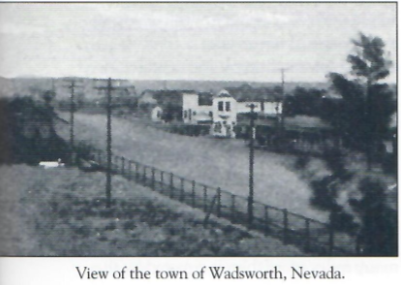
Like many railroad towns of the sort, it will soon become only a memory, for the Southern Pacific shops there now are to be removed to Reno and this will practically wipe out the town, which now has a population of perhaps 3,000. It is ever thus with the settlements in this region – here today and gone tomorrow. New places spring up in a week, and by the time some traveler has seen them and described them some shift of railroad interests has caused them be deserted villages and the next traveler cannot at all rely on finding things as described by his predecessor.
At Wadsworth I found lodgings at a hotel patronized by railroad men, and got some luscious strawberries for supper.”Even though George didn’t take a photo of the ‘hotel’ a little research shows that this place was in business. It was boarded up a few years later when this was taken.
Today there is nothing to show it was even there
May 22, 1903
(Wadsworth to Humboldt House)
“I left Wadsworth at 7 o’clock on the morning of May 22 and, leaving it, said farewell to the Truckee River, and what few vestiges of trees and grass there were in this part of Nevada. Out of Wadsworth I was facing the great desert, the plains of alkali that sifts down from the mountains on each side, and which are barren of everything except sagebrush.
As I stand before mounting and gaze across that parched, dull-gray waste of sand, alkali and rocks, with the spots of gray-green sagebrush, and think of parting from the Truckee River, which seemed so trivial a water course before, a pang of regret shoots through me. I know I shall miss the gurgling stream, and there is a sinking of the spirits that cannot be overcome as I face the leaden-hued skies and sands so unutterably dreary.
Almost one can, in fancy, see the sign of “leave hope behind all who venture here.” This is the Forty Mile Desert of Nevada that was so dreaded by the immigrants in the days when the prairie schooner, the bronco, and the mule were the only conveyances used by man to cross it.
Many perished in this desert from want, and many more from the attacks of the then hostile Indians. The old overland trail is what I was following. It is what the railroad follows, and in many places the rails have been laid directly over the old wagon tracks. At times the old trail runs right alongside of the rails, and now and then it swings off for a few hundred yards, a quarter or a half mile maybe, only to wind back again to where the surveyors kept to a straight line for the railroad and removed the rocks and sand dunes that the prairie schooners digressed to avoid.
Today NOTHING has changed, the view in either direction
I walked the first mile out of Wadsworth pushing the motor bicycle and pausing every 10 feet to take breath. Then I took to the railroad. I bumped along over the ties for 20 miles and then reached Massie, a telegraph station with a water tank for the train and section hands.
Massie used to be here
The water for these tanks is hauled in water cars from Wadsworth. At Wadsworth I had taken the precaution of adding a water bottle to my equipment, and here I mixed it with good water.
I had hardly got to riding again before I got my first puncture of the trip, and it was a beauty. It was a hole into which you could stick your finger. It was no laughing matter at the time, yet there was something bizarre about the incident that now causes me to smile, for that cut was made by a fragment of a beer bottle.
Imagine it if you please – I am in the middle of the Forty Mile Desert with a wild waste of sand and sagebrush bounding the horizon from every point of view, and, save the lonely telegraph shanty, there is not a sign of human life about. So far as the outlook is concerned, I and the telegraph operators are the sole inhabitants of a globe of sand, and yet I get my tire cut by a piece of beer bottle bearing a choice Milwaukee label.
Was it something like this? Just a guess!
It rather adds to the grotesqueness of the situation when I recall the appearance of the ground alongside the railroad track in that unholy desert, where countless men and animals have perished after being crazed by thirst. All along the tracks the ground is strewn with beer bottles that have been tossed from the car windows as the trains sped by.
Now and then one of the flying bottles struck a tie or a fellow waif and broke, but most of them landed on the sand or brush and lie there intact. I could have gathered enough of these unbroken glass beer flagons to have started a good sized bottling establishment, and, in spite of the gloom caused by my puncture. I could not help thinking what a veritable paradise this same deadly wilderness would be to some city junkman. In this land of the Terrible Thirst an habitual beer drinker surely would be turned into a raving lunatic by this sight.
It took the biggest plug I had, one with a mushroom two inches in diameter, to fix that cut, and a yard of tire tape to bind it properly.
called Upsal;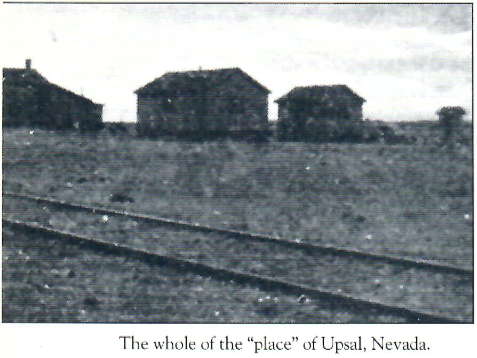
12 miles further I passed the great metropolis known as Brown’s, consisting of one house and a signpost. All about there was the same interminable landscape of sickish drab and dirt white sand and gray-green sagebrush and I was steadily bumping over the railroad ties, now between the rails and again on the outside of them, according to the depth and levelness of the sand.
** Browns
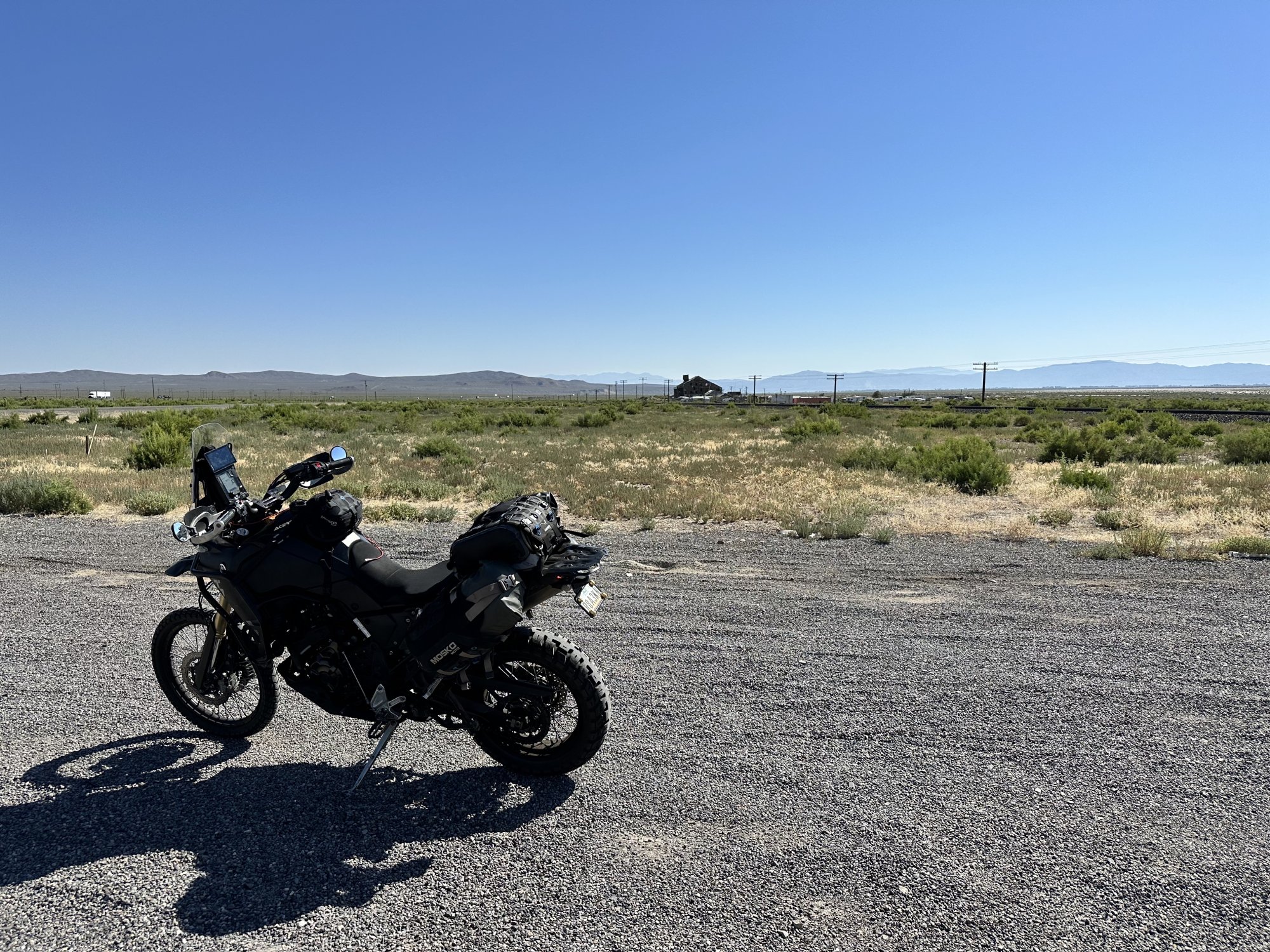
So far as signs of life other than my own were concerned I might have been a pre-Adamite soul wandering in the void world before the work of creation began;
…but the railroad was there to testify to the presence of man prior to me, and with that before me, I imagine myself to be the last of the race, who by some strange freak has escaped the blight that caused the end of the world and had been left alone on the dead planet, over which I was now coursing in search of a habitable spot.
Perhaps you can picture the cheerfulness of the place that inspired such fancies in my mind.
Imaginings of this sort are the legitimate offspring of the desert. One finds it hard to picture in the mind what meadows and pastureland and brooks and trees are like.
It is not strange that men go mad in a waste of sand so broad that to the eye it is as limitless as the sky, so dead that one feels a thrill of relief at the sight of a lizard or a swooping vulture; the wonder is that any man can see it and afterward be sane.
One or two vultures were all the flying I saw in this section in all my long, lonely bouncing over the ties. Lizards and coyotes were more plentiful – the dirty, grayish horned lizard of the desert – and while it seemed slightly to lessen the weirdness of the place to see even those forms of life, my feelings of revulsion toward the lizard, the buzzard, and the coyote augmented by a new touch of contempt for them because they would live in such a place.
Sometimes the mountain ranges to north and south that enclose the desert were visible, looking in the afternoon, like a rough edged ribbon of turquoise blue stretched, like a dado, taut against a leathern sky. More often there was visible only the sand and the dome of the sky above it, now coppery, greenish, black, gray or mottled blue, but always sullen, vicious-looking, and never calmly beautiful, for even the skies do not smile on the face of that void place.
If any of those who read this ever have ridden in one of the bowls made of slats that are known as cycle whirls, a very fair idea can be formed by them of what bouncing over railroad ties on a cycle is like unto. I have ridden an ordinary bicycle in a cycle whirl and know that it is similar in the sensation it affords to that of cycling over the ties.
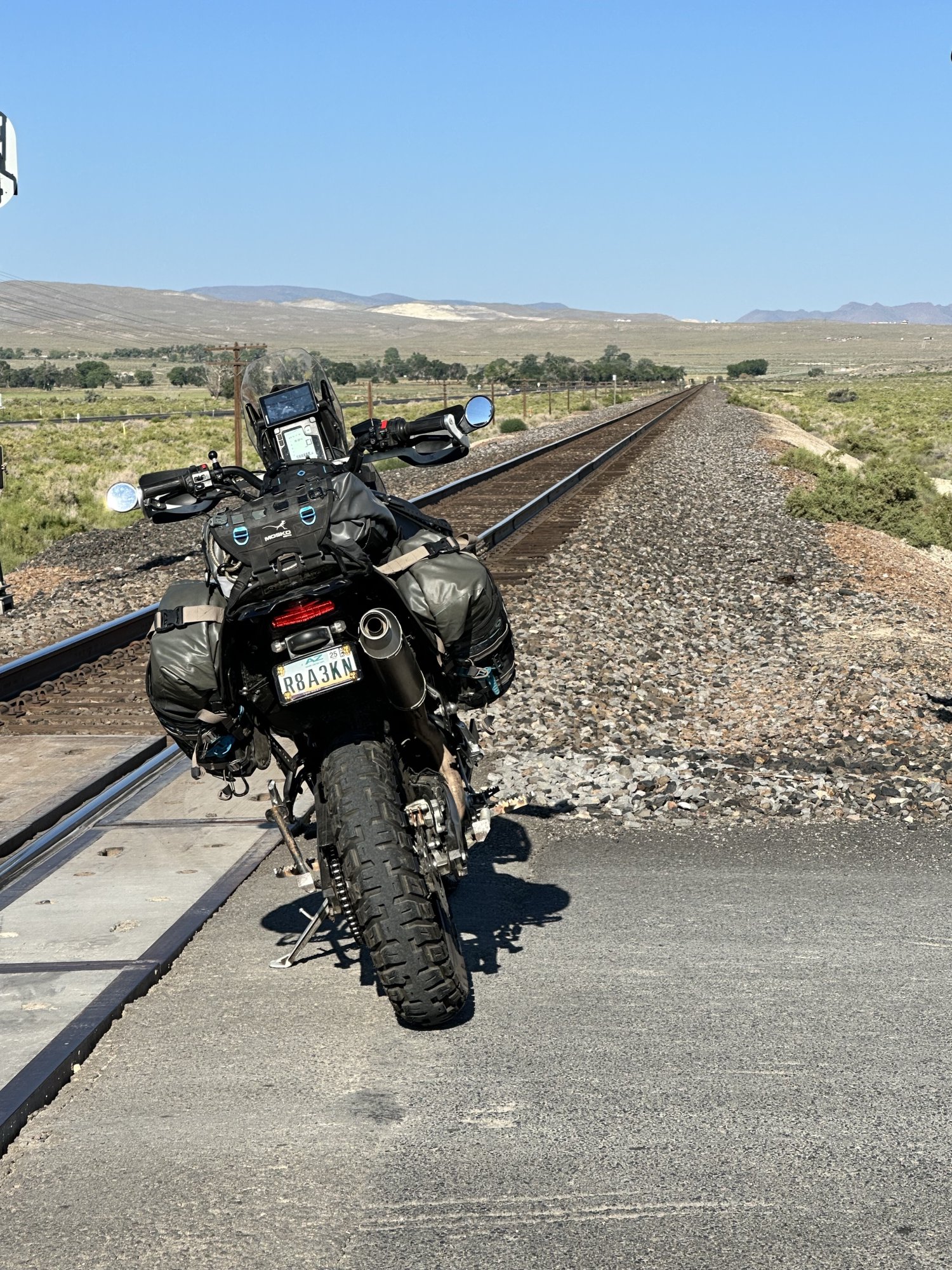
Before I had traveled half of the desert I was having trouble with my inner organs, and violent pains in the region of the kidneys compelled occasional dismounts and rests.
In the whole stretch between Wadsworth and Lovelock’s, 63 miles, I was riding the railroad with the exception of 8 or 10 miles, where I found the sand in the trail alongside hard enough to be ridden over. My education as a tie-pounder included a little trick of crossing culverts of which I became quite proud, for it was not easy; failure would have meant a plunge downward of from 10 to 50 feet.
These culverts are mere cuts in the sand under the railroad, to let the water escape without washing out the roadbed. Rainstorms in the desert came up in a minute and they are cloudbursts.
The whole country is flooded for an hour and the water races through these culverts like mountain torrents, water soaks into the sand so rapidly though, that half an hour after rain has ceased to fall, the drains and the surrounding country look as if there never had been a shower. I was caught in these showers a couple of times.
The drains under the railroad are 30 to 40 feet wide, and across them is a big beam that runs along-side the iron rails. The space between the rail and the beam about seven inches. If I had been riding between the rails I steered the wheels into this space, and by keeping the outside pedal straight up would skip across without hitting either rail or beam. If I had been riding outside the rails I rode across the drain margin of ties projecting outside the beams keeping the inside pedal high.
Sixteen miles east of Brown’s I reached Lovelock’s and the Forty Mile Desert had been crossed. I don’t know who named it but he had a poor sense of justice to deprive the desert of any part or due in distance when he gave it the Forty Mile title. It is 63 miles on the straight rails from the station at Wadsworth to that at Lovelock’s and the green growth of the town does not encroach upon the 63 miles of desert for more the 8 or 9 miles.
Lovelock, then (probably not a very early photo, earliest I could find), and now
l am speaking by railroad statistics now, for I lost my cyclometer between Reno and Wadsworth, and could not tell what my mileage was. This was the second cyclometer, the first having been bounced off the bridge over the Sacramento. I bought a third one at Lovelock’s, but I had learned by this time to depend upon the timetable of the Southern Pacific for my guide as to distance and knowledge of where I was. They kept wearing out from handling, but I got new ones at the stations.
Of course, I traveled many miles more than is covered by the railroad, because of the detours I made on the roads, but on account of my luck with cyclometers I never will know what my actual mileage was. In relation to the railroad timetables, they are handy for other information besides that of locality and distance, and this is the altitude.
It must not be imagined by those unacquainted with the country of the deserts that because they are spoken of as alkali plains that they lie in a flat lowland.
From Sacramento to Summit I was steadily rising as I have told in a previous installment of my story, the elevation at Summit being 7,017 feet. From Summit eastward there is a gradual drop, but the altitude is still high compared with sea level prairies. At Reno the elevation is 4,497 feet; at Wadsworth it is 4,085 feet; at Upsal, 4,247 feet, and at Lovelock’s, 3,977 feet.
This may help to give some idea of the dips and rises of the desert. It is all comparatively high ground. and I quickly took on the color of a mulatto riding through it.
Lovelock’s is much like an oasis, for while the Forty Mile Desert of Nevada ends there, to the east of it is the Great American Desert of Utah, and eastward beyond that is again the Red Desert of Wyoming, and I learned that the worst is not always over when the alkali wastes of Nevada have been crossed.
This oasis of Lovelock’s is about 20 miles across, and there is some excellent farming land on it. It is quite a place, but I reached it in the middle of the afternoon, and did not stop, except to get some gasoline and a cyclometer. I pushed on through Lovelock’s to Humboldt, 33 miles beyond for my overnight stop.
This made my mileage for the day 96 miles, most of it over the railroad ties. I want no more such days as that was. For 10 miles out of Lovelock’s I managed to follow the road, but then it got too sandy, and I went back to my old friends the railroad ties and bounced into Humboldt on them at 6 p.m. Humboldt is a pretty place. You are convinced of that when you look at the surrounding country, which is desert waste.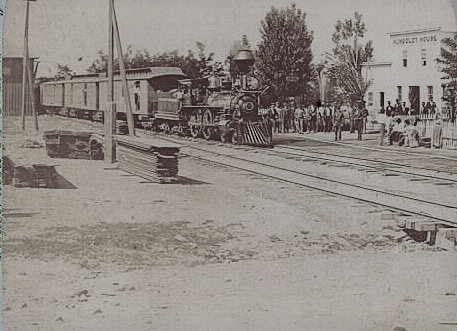
All there is of Humboldt is shown in the picture of it that I snapped with my little Kodak. The house that occupies the foreground, background and sides, and which surrounds the town, is that of the station agent, telegraph operator, and keeper of the restaurant for the passengers.
The house has a false front, and it is really a gabled structure, and climbing up the ladder to my room, I banged my head on the sloping roof.
The land immediately about the house has been cultivated by strenuous attention, and the transplanted trees that grow before the front door of this town are a source of great pride to the proprietor. I think it is because of the trees that he charges 50 cents a meal. The prevailing prices for meals In this country are 25 and 35 cents, the former price being the most common charge.”
The route so far…
continued…

 rtwPaul
You must be logged in to post a comment.