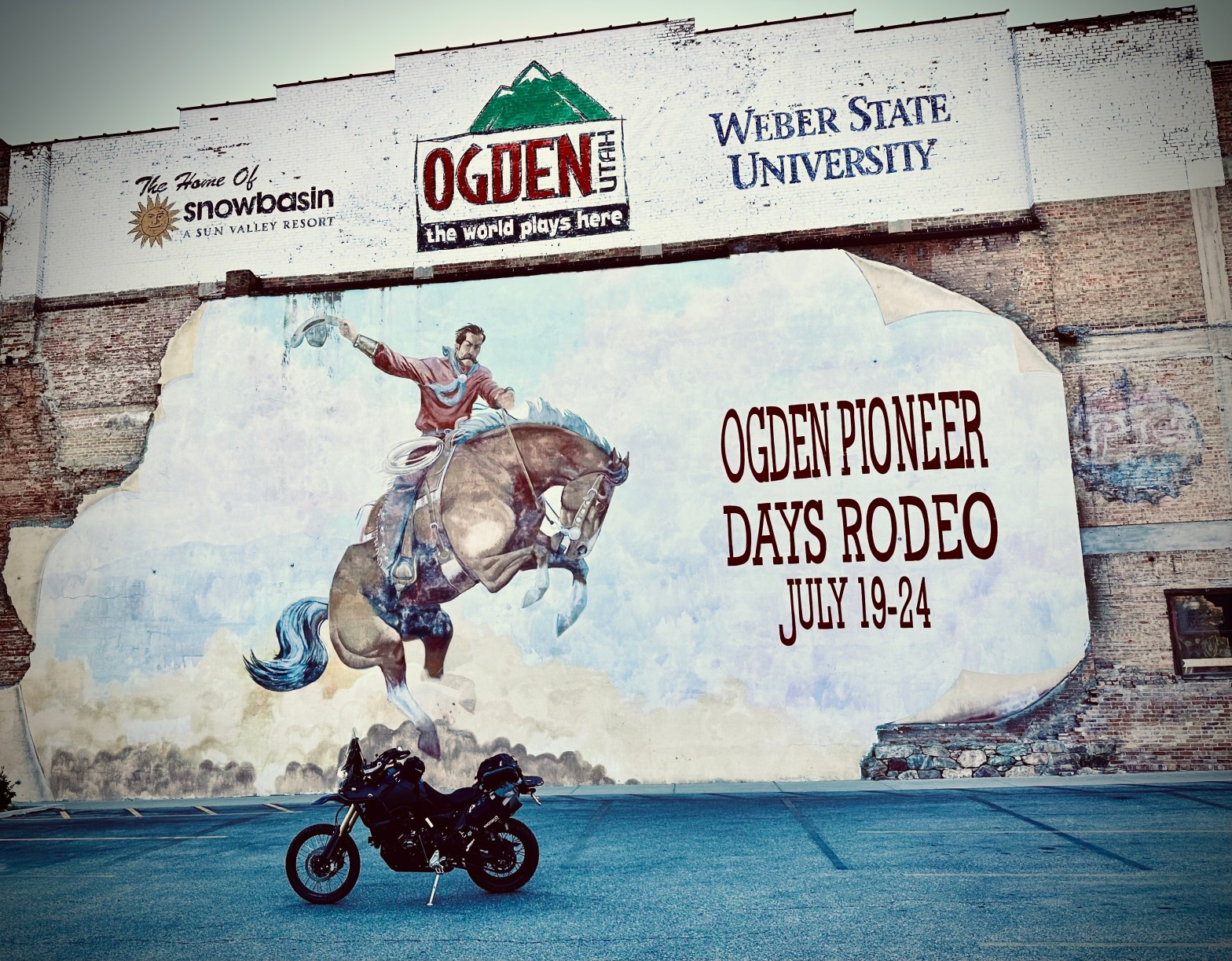
May 28, 1903
(Zenda to Ogden, UT)
“The next morning the ground was so wet that I walked half the way to Ogden. According to the railroad survey, Ogden, Utah, is 833 miles from San Francisco. I rode on the railroad track fully half the way.
What distance I actually covered getting there I cannot say with preciseness owing to having lost my cyclometers, but while there I took a map, and, summing up my detours, I figured it out that I had ridden very nearly 100 miles more than the distance by rail, or about 925 miles.
UPRR Depot & Express Office, c.1900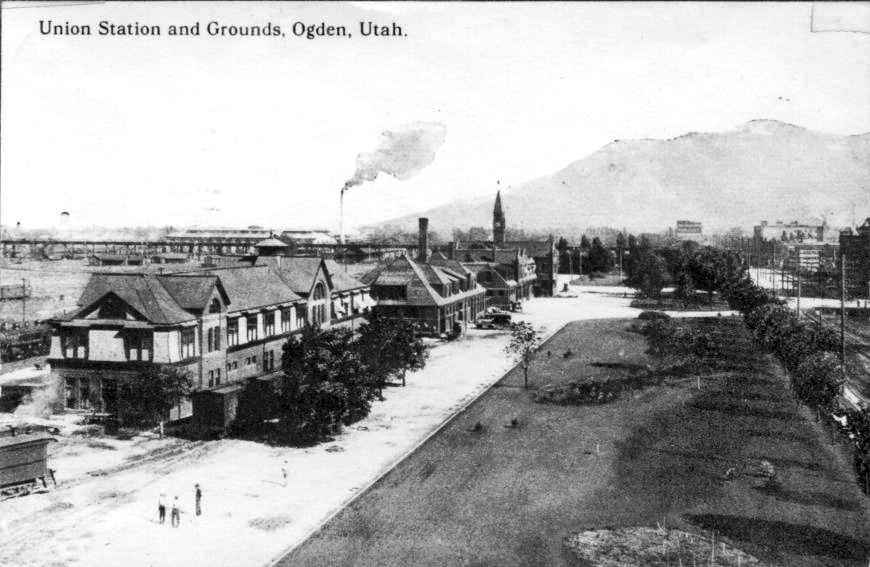
At Ogden I found a pair of new tires and a gallon of lubricating oil waiting for me at the express office. They came from San Francisco, and the charges on the tires were $2.75 and on the oil $1.50. I put on one new tire and expressed the other, with the oil, to myself at Omaha.
I got to Ogden at 11a.m., May 28, and spent the day there. I got a new pair of handlebars and put some new spokes in my wheels. While there I met up with S.C. Higgins, who has the other motorcycle in that city of 15,000 inhabitants.
**Ogden population in 2023 is estimated to be 87,286
I met him at the store of L.H. Becraft – the pioneer cyclist of Ogden and the proprietor of a large bicycle store there. I spent the evening with Mr. Higgins and slept at his house, in response to a pressing invitation.”
I’d stayed with @OnOff the night before, I was on Georges route two days now and leaving Ogden on day three, George on the other hand to this point had been on the road for 13 days and left Ogden on the morning of his fourteenth day.
Before I left I searched out the location of the bicycle store L.H. Beecroft owned and in its place or general area I found a parking lot!
besides this shop disappearing a lot of Ogden is historical and most like not changed too much in 120 years, there is a well-kept historic district around 25th street
May 29, 1903
(Ogden, UT to Evanston Depot, WY)
“I left Ogden on the 29th at 6:10 a.m. S.C. Higgins, who had been my host overnight, rode out of the city with me on his motor bicycle for three or four miles in order that I might not take the wrong road. He is a genuine enthusiast, although well past 40 years of age, I should judge, and he took the liveliest sort of interest in my trip and the success of my undertaking. Mr. Higgins is a machinist, and several years ago he made a motor bicycle for himself. Now he rides an Indian.
George didn’t include a photo of the Indian but one from the 1901-1903 era would look something like this pristine example I showed earlier in this report of a 1903 model on display in the Barbar Museum in Birmingham, Alabama
![[IMG]](https://photos.smugmug.com/Unlisted/USA-2019-S10/n-WmqJjv/USA-2019/i-dJ2KkTP/0/7f36c5bb/X2/barbers-156-X2.jpg)
It may be said that I splashed out of Ogden. That is the way it comes to me as I now recall it. It had rained for three weeks before I arrived there. The roads in all directions were muddy and the streams swollen.
I was now entering the Rockies, and almost as soon as I got out of Ogden I began to encounter mountain streams, which I had to wade across. They were composed largely of melted snow water and were icy cold. At the first one I stopped, removed my foot gearing, took off my leggings, rolled up my trousers, and splashed across barefooted, and, except that the water was too cold, I rather enjoyed it.
After going a mile I came to another stream and repeated the undressing performance. I did not enjoy it so much this time. Then the streams began to come along two or three to the mile, and I quit the undressing part and waded across with my shoes and all on.
Sometimes the water was knee deep and a couple of times my motor got more cooling than it wanted and I had a job starting it again.
In the forenoon of that day I waded more than a dozen of these mountain streams. It is a well watered country this, and it abounds in orchards and farming lands cultivated by Mormon industry. The streams I crossed were racing toward the Weber River as it ran through the Weber Canyon, which extends 140 miles southeast to Granger.
looking east towards Weber Canyon today
I am following the wagon road now, and 12 miles out of Ogden I enter the Weber Canyon. Turning to the left, I find myself walled-in by the grand granite walls of the canyon that tower upward to the clouds, and I come abruptly upon Devil’s Gate, where the waters of the river fall from a great height and thrash around a sharp bend that has been obstructed for ages by a helter-skelter fall of great blocks of stone from above.
It is a seething cauldron of water that rushes with insane, frothing fury around or over the obstructions, and one is impressed with the idea that the name is an apt one. A little further on I passed the Devil’s Slide, another place well named, where the rocks rise in two
Devil’s Slide, c.1900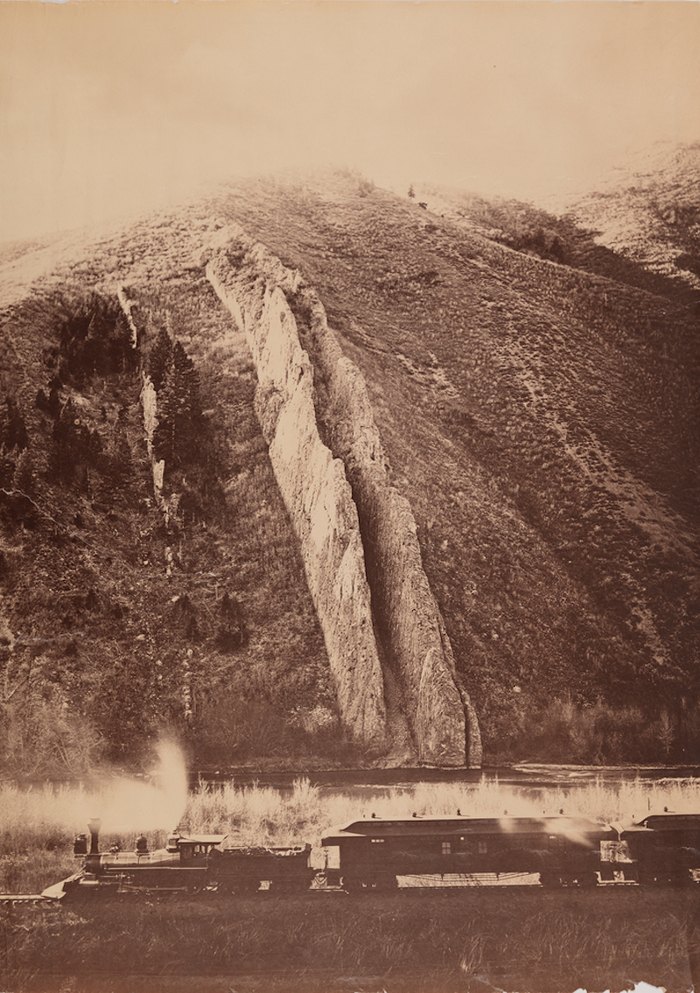
and today, even though it’s the same size, somehow it seems smaller and is by a rest stop at the side of the road
…perpendicular walls, hardly five yards apart, from the floor of the canyon to the mountain summit. It looks as if the stone had been sawed away by man, so sheer are the sides. But these are only a couple of the many wonderful and grandly picturesque phenomena of nature that I encounter from here on for many miles.
It is a beautiful country, and the scenes shift from wild and rugged natural grandeurs in the narrow parts of the canyon to pastoral loveliness in the places where the mountain pass broadens and the small but fertile and splendidly kept farms of Mormon settlers are found here and there where the sides slopes to the river.
As I go on toward Echo City, 40 miles from Ogden, I get out of the narrow part of the canyon and tilled land becomes more common.
Every one from 50 miles around was bound for Echo City or Evanston on that day, May 29, to see President Roosevelt, whose train stopped in passing long enough for him to make a speech at all the towns of any size.
For this reason there was an unusual amount of travel on the roads, and I was repeatedly forced so far over to the side that I had to dismount to escape an upset.
The farmers seemed to think I had no right on the road when they wanted to use it, and several swore as they called to me to get out of the way. One man abused me roundly, and told me I ought to get off the road altogether with my damned “bisickle.” I did an indiscreet thing in answering him in kind, and he pulled up his team with the intention of getting off and horsewhipping me or to get a steady position to take a pot shot at me with a revolver. I don’t know which – I didn’t stop to learn.
I let out my motor and quickly got around a bend in the road out of sight, and kept going, so that he did not see me again. I felt that tempers are too uncertain in that part of the country to risk a row with a native. I was alone in the land of the Mormons, and they are famed for the way they stick to one of their clan.
I reached Echo City, a railroad settlement of about 200 persons, and, after eating, pushed right on toward Evanston. East of Echo City the canyon narrows again, and here it is known as Echo Gorge.
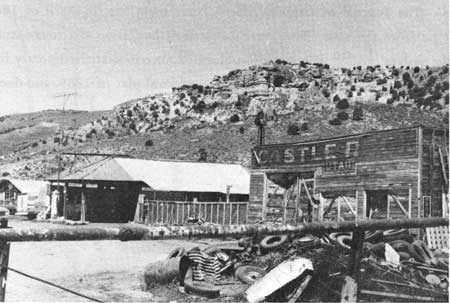
There is very little left of Echo City that I could see, I couldn’t get too close due to a large amount of road work and heavy equipment
I had my fill of it, and the echoes of my ride through it lasted for days. The roads were in frightful condition owing to three rainy weeks. In many places it was harder traveling on them than over my friends the railroad ties. In the 80 miles that I rode it is 76 by railroad – between Ogden and Evanston on this day of grace my insides were shaken together like a barrelful of eggs rolling down a mountainside.
My shaking-up was received in going uphill, though, for I found by consulting my guide that I had climbed 2,400 feet that day. The elevation at Ogden being 4,301 feet and at Evanston 6,759 feet.
At night my back felt as if some good husky man with a club had used it on me heavily. The new belt rim that I had put on in the morning got shot full of holes that day by being punched against sharp rocks at the roadside. It is a strenuous country, and must have been plenty pleasing to the President. I had little chance to revel in the magnificent scenery, but I knew about the Pulpit Rock from which Brigham Young delivered a Sunday sermon during the pilgrimage of the Mormons to their settlement at Salt Lake City, and I had a glance at it as I rode away from Echo City.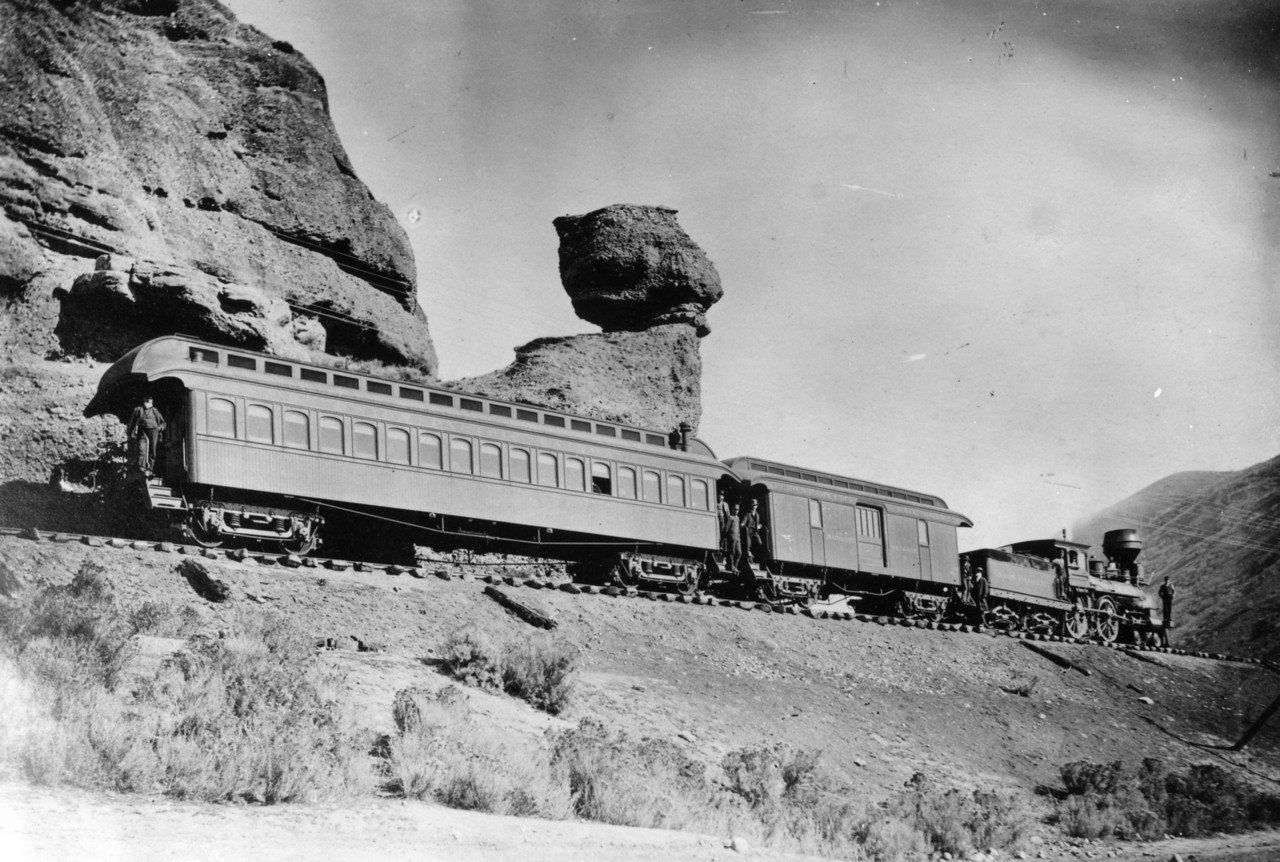
Sixteen miles east from my luncheon stop I passed the towering sandstone bluffs, with turreted tops naturally formed, that are known as Castle Rocks, and lend their name to a railroad station of the Union Pacific there.
If any one got off there, though, you would surely have a spell of wondering what they were going to do, for there is no village of any sort. The day was nice enough so far as temperature was concerned, but the story of what had been in the recent past was told to me just before I got into Evanston by the sight of thousands of sheep carcasses strewn on the hillsides and even right along the sides of the road. They had been killed by snow and hailstorms, only a few days before.
*Room in which Wyman slept
It was 8:35 p.m. when I reached Evanston in Wyoming, just across the State line from Utah, and, although this is a town of something over 2,000 persons, (*2023 population of 11,959) with half a dozen hotels, the place was crowded with visitors.
Every cowboy, ranchman, farmer and miner for many miles around had been there to hear the President speak in the afternoon, and at night food was at famine prices and sleeping accommodations simply not to be had.
I was not wanted anywhere and I felt the slight in the difference between welcome given to the President and to me keenly. After trying at a couple of hotels and boarding houses I made up my mind that I would have to sit it out.
**Not a Wyman photo
Chairs however, were at a premium, and I stood and watched a poker game at the hotel until midnight, and then strolled over to the railroad station where I found a chair, and in that I bunked, sore as a stone bruise until morning, leaving the town at 6:20 o’clock.”
May 30, 1903
(Evanston to Granger, WY)
“After riding about six miles that day I bumped into a rut and the stem of my handlebars snapped, but there was about an inch of the stem left, and I hammered it down with my wrench into the head tube and managed to make it do. This repair lasted to Chicago. I took to the railroad leaving Evanston, as there has been a new section built there, cutting off some distance and leading through a newly completed tunnel at Altamont, 13 miles from Evanston.
**not a Wyman photo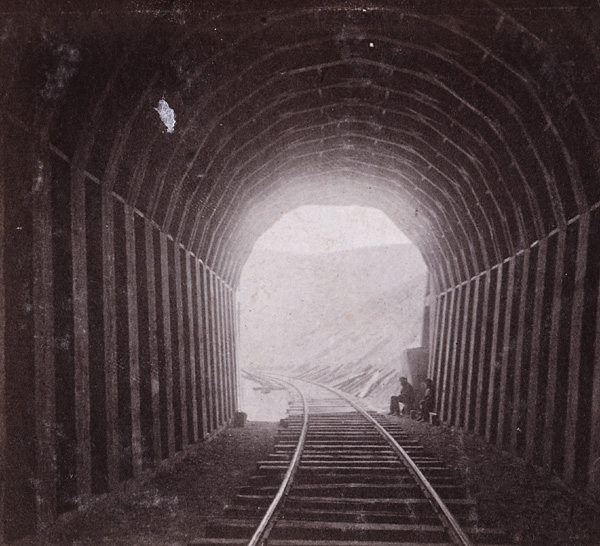
It was early morning when I reached the tunnel. It is a mile and a half long. A train passed me and through the tunnel just before I got to it. It takes half an hour for the smoke to get out of the tunnel after a train passes through.
I sat down to wait at the station and got to talking to an operator. He calmly informed me that several other trains would be along before long, and that it would not be safe for me to go through the tunnel for hours. Such luck!
The only thing for me to do was to follow the trail over the summit through which the tunnel runs. This I did, walking and pushing my bicycle and stopping every few minutes to “breathe” myself. I ascended 300 feet in less than half a mile. I rode down on the other side using both hand brake and the coaster brake.
I forsook the railroad after this and followed the road through Spring Valley and Carter to Granger, riding past the famed buttes, or table mountains of the Bad Lands. Bad they are, too. Even the road was marshy and muddy with clayey, sticky mud that just hugged my tires and coaxed them to stay with it. I was going down-grade now from Altamont to Granger.
Carter, WY c.1900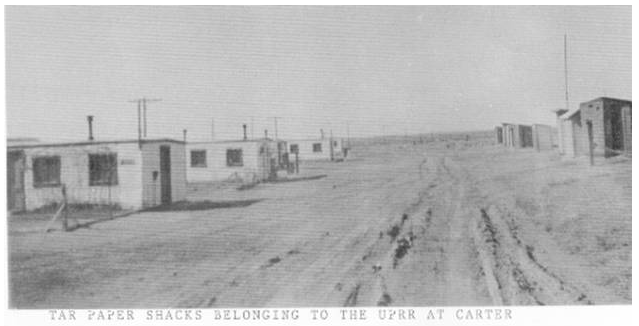
Carter today
It is a great country at Carter, where altitude is 6,507 feet, it is a wonderful sight to see the buttes with seashells on their sides marking the high water mark of a prehistoric flood. Only it is a pity the water would not dry up entirely and give a bicycle a chance.
I covered 85 miles on this day and it was one more like the three preceding days. An idea of climbing can be gained by stating that at Evanston the elevation is 6,759 feet, at Altamont 7,395 feet, and at Granger 6,279 feet. There were more round stones the size of baseballs on that piece of trail over the Altamont summit than ever I saw before in my life.
At times they all seemed to be rolling around in an effort to get under my tires. If ever I travel through Nevada. Utah and Wyoming again on a bicycle it will be with a railroad track attachment. The telegraph operators at the lonely stations in the deserts have them to travel on back and forth from their homes to their offices. Putting the flanged guide wheels of the attachment on one rail the wheels of the bicycle are kept strictly in place on the opposite rail, and splendid time can be made.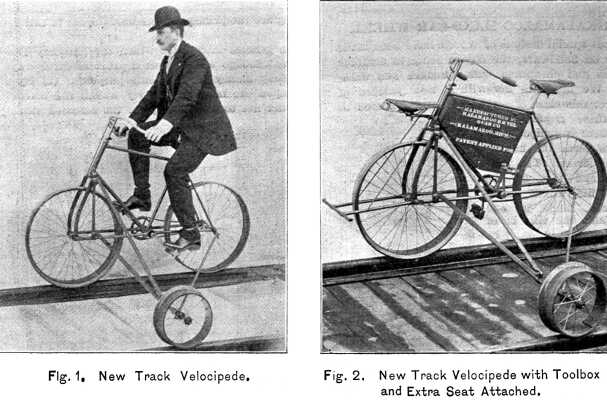
With such an attachment and a motor bicycle one could follow the railroad and make 150 miles a day, rain, snow or sunshine.”
** If you want to read more about the Velocipede click here for an article from 1895. Michigan farmer George Sheffield invented the first three-wheeled railroad velocipede in 1877. Getting tired of walking the tracks every day, Sheffield came up with the idea of using both feet and hand cranks to move the vehicle. Two years later he applied for a patent. During most of the time in between, he kept his invention secret from others, only riding it at night as he had no right to use the rails.
George Wymans Route so far, San Francisco to Grainger Wyoming
continued…

 rtwPaul
You must be logged in to post a comment.