
June 19, 1903
(Naperville to Chicago, IL)
“I was on fine stone roads by this time, and only 25 miles from Chicago. I pedaled Into the Windy City in five and a half hours the next day, June 19. As may be imagined, I was tired after pedaling 25 miles, and not only physically weary, but I was mentally dejected because of the accident to my motor. On the outskirts of the city I sat down on the curb to rest and meditate, and I was aroused by a local rider who, fancying I was in trouble, stopped to offer assistance.

I looked for a skyline photo of Chicago at the turn of the century and sadly couldn’t find one coming in from the west as I did
…but to give you a feel of Chicago at the turn of the century this is an interesting short film and gives you a slight glimpse of what George Wyman possibly saw as he entered the city
Once I was fairly in Chicago I sought to get a new motor crank, but found there was none to be had, so I telegraphed to San Francisco for one. The motor crank was the last thing that was expected to break. I had parts of every sort excepting that one along with me, and these were unused, while the one thing I could not replace was the one that broke. This showed that one never can tell what to expect in a cross-country journey of this sort.
After telegraphing for the motor crank I knew I would have to lay up in Chicago for a while, so I went out to engage lodgings. I found a nice-looking boarding house, and chose it in preference to a hotel. I engaged board for four days. When I made a light in the room, however, I found I had company – insects in the bed as big as canary birds. At least they looked that big to me. I hastily decamped with my few belongings, and walked the streets for three hours, feeling timid about making another attempt to get accommodations. “
June 20-22, 1903
(Layover in Chicago, IL)
“I was thoroughly disgusted with Chicago from that time on. I eventually went to a hotel where everything was all right, but my dislike of Chicago increased during the five days of my stay there.
It rained nearly every day, and the soot from the soft coal smoke nearly strangled me, after my being accustomed to the pure air of the mountains.
The things that impressed me most in Chicago were the way that the inhabitants ran about the streets as if they were lost or going to a fire, and the number of drunken men and women in the streets. I never saw so much drunkenness In my life anywhere before.
I went to some of the theatres, but my impression of the city was not helped by that. I simply abhorred the place.”

The Art Institute of Chicago had opened less than a decade before George Wyman’s arrival. As he was ‘stuck’ in the city for days he most likely was in the area. Nowadays if you stand across the street and admire the view while trying to not get run over, little has changed in 120 years in regards to the view.

Today’s Google Street View
…but if you look, back in 1903 standing in the middle of Adams Street facing Michigan Avenue, the road is no longer dirt and those tram lines are long gone
…why mention Adams Street? Well, Adams Street in 1926, just 23 years after George was there became the official start point of Route 66, from this point you could travel 2448 miles to the California coast at Santa Monica in a week or so, probably way beyond George’s comprehension in 1903.
If you turn your back to the AIC and look to your right there is the Route 66 sign, and very little else to signify you are at the beginning of the Mother Road. I really wanted to get my bike under the sign on the sidewalk but wow is that intersection busy and the road right there is a bus lane, plus there’s a fire hydrant and a cop just out of the shot, this will have to do!

I went up to the end of the block, took a left and rode State Street out of town…just like George I wanted out of there, it was 4.40pm and around 100c, traffic was insane.
…as George is currently broken down! Here’s some detail on his motor bicycle that the George Wyman Foundation put together –
Size Matters – Originally published April 2016
The engine size (displacement) of Wyman’s California motorcycle matters. Was it 90cc (5.5 cu.in) or 200cc (12 cu.in). Both sizes have been widely reported in connection with the Wyman California. Our research team has been examining this issue to determine the likely displacement of the California that carried Wyman, with all his gear, 3,800 miles across America.
It is unlikely a 90cc displacement would produce 1.25-Horsepower often attributed to his motorcycle. Here is a quote from an article written for the Wikipedia Motorized Bicycle page…
“Other sources state that the Marks engine in the California was only 90 cc in displacement, but a 1901-vintage 90 cc low-compression four-cycle engine running the 30-octane gasoline of the day was unlikely to generate 1.5 horsepower and 25 mph on the California, which weighed some 75-80 pounds, not counting fuel, oil, and rider.” Rafferty, Tod, The Complete Illustrated Encyclopedia of American Motorcycles, Philadelphia, PA: Courage Books, page 22.
The motorcycle Wyman used to ride from San Francisco to New York City has been identified as a 1902 California designed by Roy C. Marks, of the California Motor Company. It could have been a Regular 1903 Model California. In 1902, Wyman acquired (bought?) a California. He rode it from San Francisco, over the Sierra Nevada Mountains, to Reno and back that summer. This ride inspired him to attempt a transcontinental journey across the United States. Since Wyman and the CMC were both in San Francisco, he may have collaborated with the CMC on the project. Either to get the bike he rode to Reno in tip-top shape and modifying it for the trip across the country. Or, CMC provided him with the latest model in exchange for promotional rights. (We are conducting research to shed more light on this issue.)
On September 30, 1902, Marks was granted two US Patents for his designs:
- EXPLOSIVE-ENGINE FOR MOTOR-VEHICLE, US Patent 710,329
- CARBURETER FOR EXPLOSIVE-ENGINES, US Patent 710,330 (sic)
There is no mention of the displacement of the cylinder volume not occupied by the piston in the description of Marks’ design. This is not unusual, though. It would be to his advantage to not specify the size of the engine, allowing for future size changes in the applied for design. Figure 2, depicts the motor cylinder showing the internal space of the combustion chamber.
An examination of the diagram above indicates the volume of the cylinder, not occupied by the piston, to be about 60% to 65% of the total volume between the bottom of the cylinder and the top of the head assembly. We will use 62.5% in our calculation.
Comparing the Wyman motorcycle with the 1902 California in the Dave Scoffone collection provides the opportunity to examine the relative size differences between motor cylinders. Even with the slight viewing angle difference the cylinders appear to be identical, right down to the number of heat transfer fins. A cylinder of 90cc displacement would be noticeably more slender or roughly half the size.
1902 California today and “Snip” of Broken Belt Photo
Dave measured the cylinder of the 1902 California in his collection. The length from the base of the cylinder to the head assembly is 6 inches. The circumference of the outside wall at the base of the cylinder, below the heat fins, is 9.5 inches. The cylinder walls of the patent diagram appear to be 3/8 or 1/2 inches thick, given a 6-inch length. For our gross calculation, we will use 1/2 inch.
The formula for calculating the volume of a cylinder is: V = pi r^2 (length),
given the cylinder….
- Length: 6 inches
- Outer circumference: 9.5 inches
- Outer diameter: 3.03 = 9.5 divided by 3.14
- Cylinder wall thickness: .5 inches
- Inside diameter: 2.03 = 3.03 minus 1 inch for cylinder wall thickness
- Inside radius: 1.015 = 2.03 divided by 2
therefore…
- Volume cylinder: 19.32 = 3.14 times (1.015^2) times 6
- Displacement: 12.08 cu in. = 19.32 times 62.5% of total cylinder volume not occupied by the piston.
It is conclusive to our research team that the engine size of Wyman’s motorcycle was not 90cc (5.5 cu.in), but 200cc. Going forward, the Project will refer to Wyman’s motor bicycle as being a 200cc, 1.25-horsepower 1902 California motorcycle.
June 23, 1903
(Chicago to Kensington, IL)
“It was not until the morning of this day, June 23, that I got my new motor crank by express, and it took me nearly all day to fit it and get the engine together again. I lost no time in getting away from the Windy City. I did not want to stop there one hour longer than I was obliged to do. I left there that same evening.
I would “blow in” to New York in a week or so. The worst roads I knew must surely be behind me, and, with better highways, I calculated that I would have no more trouble with my motor bicycle. I reckoned without thought of the cumulative effects of the continuous battering that the machine was receiving. It has proven itself a wonderfully staunch steed, but no vehicle could stand what I imposed upon the 90-pound vehicle, nor should any be expected to do so.
Before I got through with my trip I had, as will he seen, a vivid personal experience that put me into thorough sympathy with the Deacon and his one-horse shay.
As I have said, I did not want to remain in Chicago one minute longer than was necessary. and accordingly I left there at 5:30 p.m., on June 23, and made my way to Kensington, 23 miles east.”
Kensington Rail Depot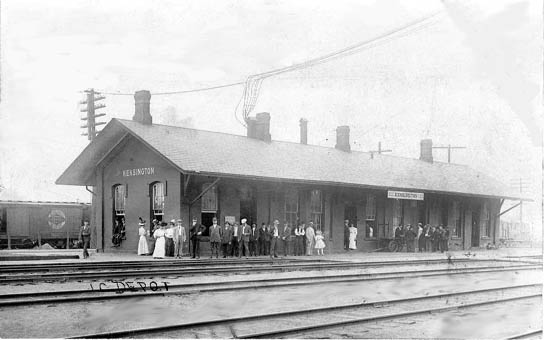
Route so far, San Francisco to Kensington IL
continued…

 rtwPaul
You must be logged in to post a comment.